Align with Business Strategy
Align strategy of business capability improvement and execution.
Large enterprises are complex. Multiple lines of business, each with its own identity, its own strategy, its own agenda. Getting them aligned on anything is a political minefield.
Yet without alignment, you get duplication, contradiction, and waste. Every department builds its own solutions. Data doesn't flow. Knowledge stays siloed. The enterprise as a whole is less than the sum of its parts.
The Use Case Tree is the single artifact that all lines of business can talk to. One shared structure. One source of truth for what the organization is trying to accomplish.
Business Capability Maps: Good Idea, Poor Execution
Most large organizations have an Enterprise Architecture or Business Architecture department that maintains a business capability map—a hierarchical view of what the organization does.
Here's an example of a capability map with applications mapped to it (from BiZZdesign):
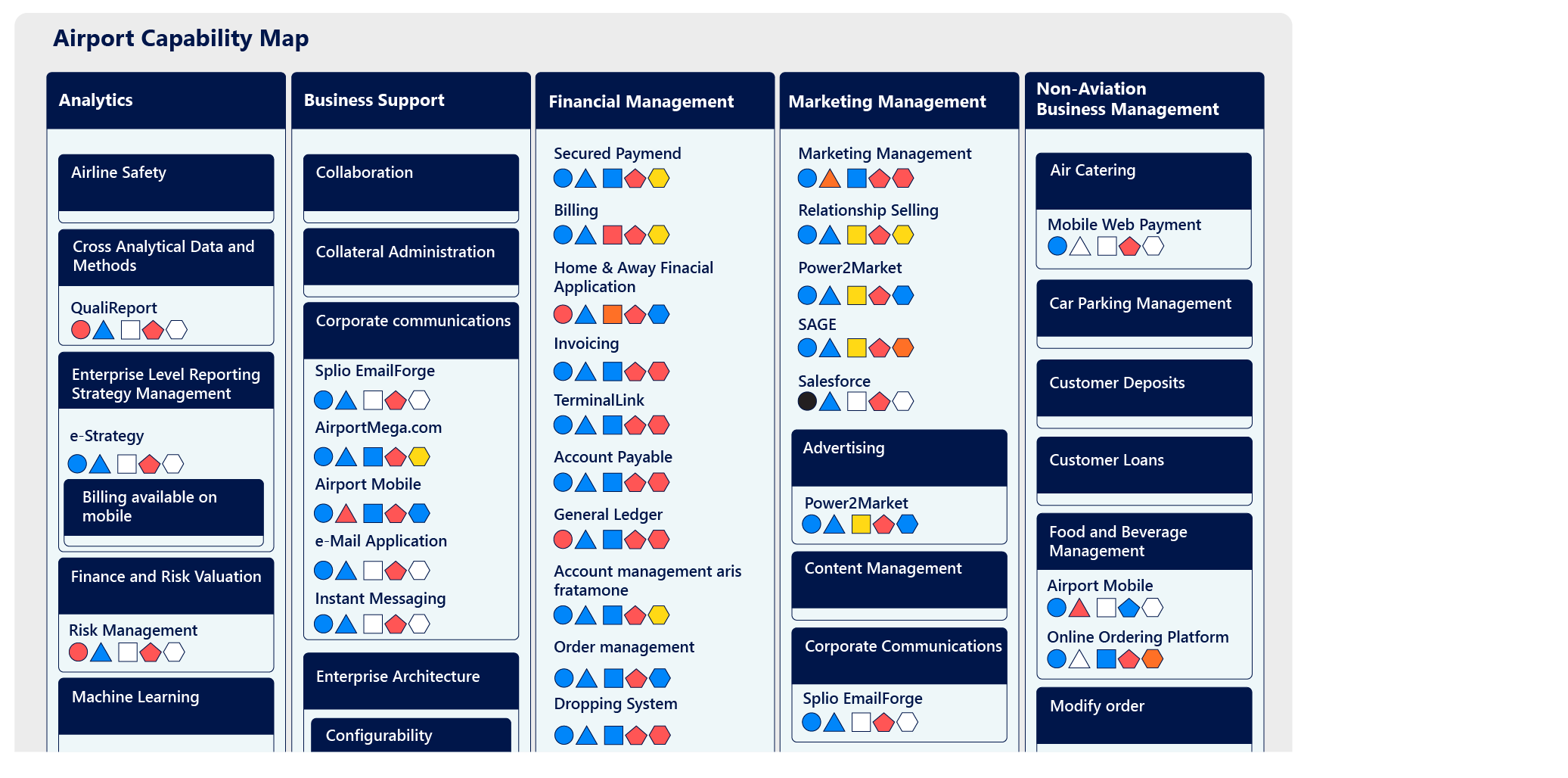
In theory, these maps align strategy to execution. In practice:
- They're just pictures - Maintained in PowerPoint or Visio, disconnected from reality
- Nobody uses them - Pretty diagrams that live in SharePoint folders, never opened after the initial workshop
- No connection to systems - The capability map says one thing, the actual systems do another
- No connection to data - APIs, data models, and interfaces don't reflect the capability structure
- No connection to processes - The actual work flows differently than the boxes suggest
The capability map becomes shelf-ware. A planning artifact that has no impact on execution.
The Use Case Tree: Capability Map That Executes
The Use Case Tree takes the business capability map concept and makes it executable.
At the highest levels, the Use Case Tree looks identical to a capability map—the same hierarchical structure of what the organization does. But it goes further:
- Each capability breaks down into use cases - Concrete, deliverable units of business value
- Each use case has stories, outcomes, concepts - Real requirements, not abstract boxes
- The structure lives in the EKG - Not a picture, but a model that systems actually use
- Changes propagate - Update the structure, and downstream systems reflect it
This is the next level: a capability map that doesn't just describe what the organization does, but actually drives what the organization does.
From Politics to Progress
When every line of business can see their priorities in the same structure—when they can trace from strategic goals to concrete deliverables—alignment becomes possible.
Not easy. Still political. But possible.
The Use Case Tree doesn't eliminate organizational complexity. It makes the complexity visible, navigable, and actionable.
See Also
Sources
- Marc Lankhorst, Sven van Dijk - What are Business Capabilities & How to Identify them?
- Business Capability Models: Why You Might Be Missing Out on Better Business Outcomes