Enable Reuse
Building the foundation for composable, scalable enterprise knowledge
Without reuse, there is no EKG. Just another pile of data that nobody can build on.
Reuse Enablement means designing every knowledge asset—use case, ontology, data product, workflow—so it can be safely reused across teams, domains, and generations of technology. Not as an afterthought. As the core architectural principle.
The Problem: Starting from Zero, Every Time
Enterprises waste enormous effort solving the same problems repeatedly. Integrating the same data. Remodeling the same business rules. Recreating the same workflows. Different team, same work, zero leverage.
Why? Knowledge is not shared as reusable components.
It lives in silos—spreadsheets, slide decks, bespoke systems. Every project starts from scratch. Every team reinvents what the team next door built last year.
A reuse-enabled organization captures work as semantically defined, governed components. Discoverable. Composable. Anywhere in the enterprise.
The result:
- Drastically reduced duplication and cost
- Higher quality through shared, tested models
- Faster delivery—each use case accelerates the next
- Alignment across business and technology
Beyond Data: Reusing Behavior, Not Just Triples
Most semantic technology initiatives have been data-driven—integration specialists and ontology engineers delivering powerful data harmonization. Useful, but it rarely transforms how the enterprise actually works.
The Use Case Tree Method shifts the paradigm. Reuse isn't a data exercise. It's the foundation for application composition. Not just triples and ontologies—behavior itself, expressed as Stories and Workflows.
Just as object-oriented programming in the 1980s combined data and methods into a reusable "object," the Use Case Tree (UCT) combines data, logic, and process into a reusable semantic package: a use case that contains its meaning (ontology), its data products, and its behaviour (stories, workflows, outcomes).
This is the crucial difference:
The Use Case Tree Method paradigm shift
Instead of describing data that others must code against, the Use Case Tree Method captures the behaviour itself — executable, governed, and reusable across domains — without necessarily writing code at all.
In this sense, a Use Case in the EKG is just as real and reusable as a software package in the JavaScript or Python ecosystems. Each can be discovered, installed, versioned, extended, and composed — but the EKG package operates at the semantic and business level, spanning data, logic, and meaning.
That's why reuse is not a side effect of the EKG. It's the reason the EKG exists.
From DIKW to EKGF: Making Knowledge Executable
The well-known DIKW Model (Data → Information → Knowledge → Wisdom) has guided information management for decades. But it assumes that Wisdom naturally follows from Knowledge — as if understanding automatically produces action. In practice, enterprises rarely reach that state because the bridge from knowing to doing is missing.
The Use Case Tree Method extends this model by adding the operational dimension: knowledge becomes behaviour, behaviour becomes reusable, and reuse powers composability. This is the Path to Executable Knowledge — where understanding turns into governed, shareable, and actionable intelligence.
The diagram below visualises this shift — showing how the Use Case Tree Method transforms the classic DIKW hierarchy into a living model of executable, reusable knowledge.
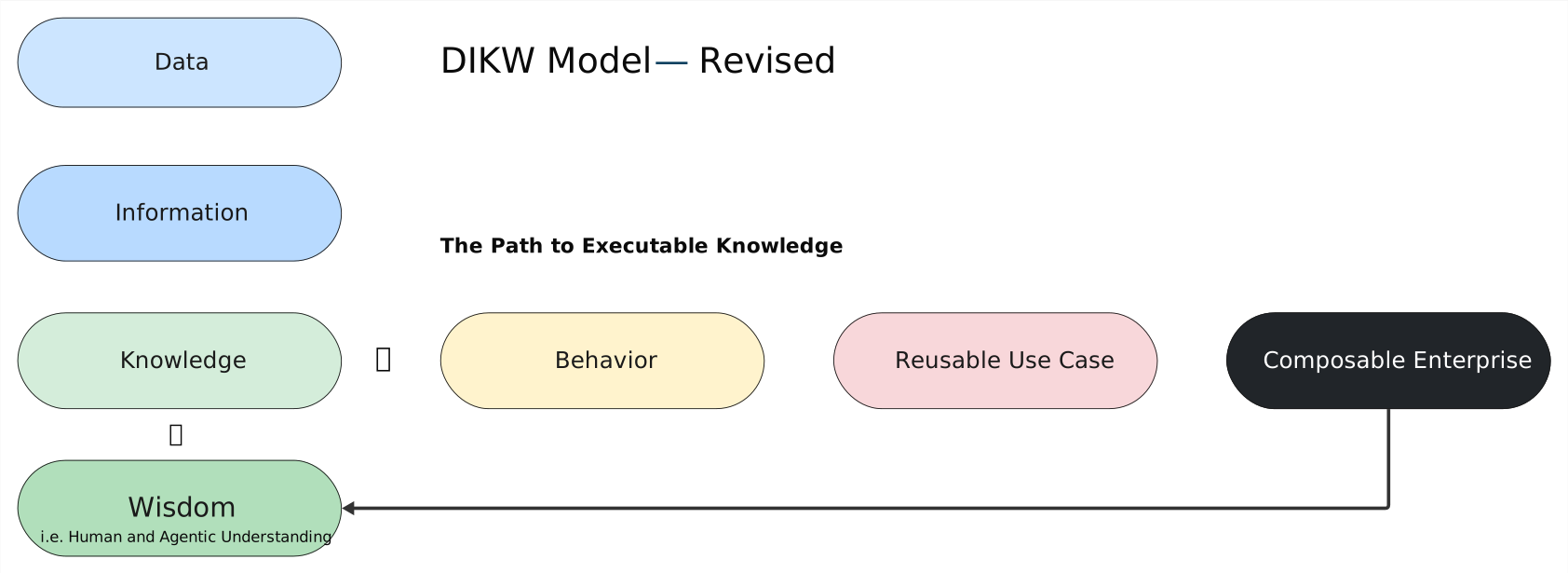
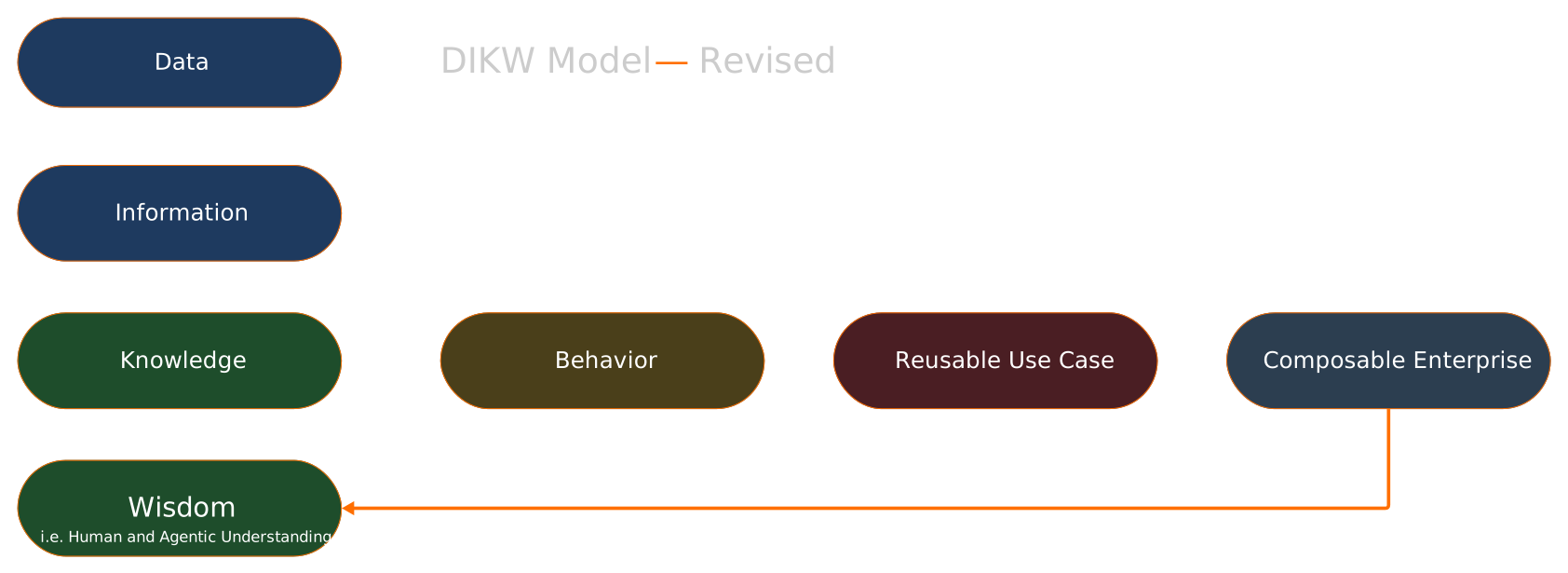
Traditional DIKW ends at understanding. The Use Case Tree Method continues by modelling behaviour, packaging it as reusable use cases, and feeding it back into a composable enterprise — closing the loop between data, knowledge, and operational wisdom.
The Role of the Use Case Tree (UCT)
In the Use Case Tree Method, the Use Case Tree (UCT) is the mechanism that makes reuse practical and governed.
Each node in the UCT acts as a semantic package — a defined, versioned, and discoverable unit of business capability. Within a UCT package, teams can register:
- Ontologies and shapes defining meaning and validation
- Stories (tool functions or APIs) that implement reusable logic
- Data products describing and delivering reusable datasets
- Workflows and policies orchestrating repeatable patterns
Every successful technology ecosystem has a way to share reusable components — the JavaScript world has npm with over 3.5 million packages, the Python world has PyPI with over 600,000 packages, and so on — each enabling developers to build upon a vast ecosystem of reusable components. The Use Case Tree (UCT) plays the same role for the Enterprise Knowledge Graph (EKG): it is the semantic package manager that makes every business capability, dataset, and workflow discoverable, versioned, and ready for reuse across the organisation.
Reuse Enablement vs. Composable Business
Two sides of the same semantic coin
While Reuse Enablement and Composable Business share the same foundation, they operate at different levels of abstraction. The table below summarises their relationship within the Use Case Tree Method.
| Aspect | Composable Business | Reuse Enablement |
|---|---|---|
| Focus / Orientation | How business capabilities are composed, orchestrated, and evolved | How knowledge assets and components are packaged and shared |
| Primary Question | "How do we assemble business capabilities from reusable parts to adapt to change?" | "How do we design those reusable parts so they can be assembled safely and meaningfully?" |
| Scope | Business and operational level — orchestrating Use Cases, Personas, and Stories into composable outcomes. | Technical and semantic level — creating and governing reusable artifacts: ontologies, datasets, shapes, workflows, data products, and Stories. |
| Key Mechanism | Use Case Tree (UCT) as the orchestration layer: composing and aligning modular business capabilities. | Use Case Tree (UCT) as the packaging layer: publishing reusable components and metadata to the Enterprise Knowledge Graph (EKG) for discovery and re-use. |
| Relationship to the EKG | The EKG provides the shared semantics and service interfaces that make cross-use-case orchestration possible. | The EKG provides the shared identifiers, ontologies, and provenance that make reuse safe and traceable. |
| Value Proposition | Agility and adaptability: the ability to reconfigure the enterprise dynamically in response to change. | Efficiency and consistency: the ability to reduce duplication and accelerate delivery through reusable, versioned components. |
| Primary Users | Business and solution architects; transformation leads. | Data and knowledge engineers; ontology and platform teams. |
| Outcome | Composable business capabilities and adaptive workflows. | Reusable semantic components and data products. |
| Relationship to Each Other | Composable business depends on reuse. Without reusable components, there is nothing to compose. | Reuse finds purpose in composability. Without higher-level composition, reuse is just technical hygiene. |
Two sides of the same semantic coin
Reuse Enablement creates the building blocks.
Composable Business assembles them into living systems.
Both rely on the Use Case Tree (UCT) as the semantic package manager of the Enterprise Knowledge Graph — governing how business, data, and technical artifacts are versioned, discoverable, and composable.
How to Enable Reuse in Practice
-
Model once, reuse everywhere: design ontologies, shapes, and stories as modular assets stored and versioned in the EKG.
-
Publish via the UCT: register components as packages with clear ownership, metadata, and dependency relationships.
-
Govern for trust: validate with SHACL, record provenance, enforce entitlements and lifecycle policies.
-
Discover and compose: make all reusable artifacts searchable and connectable across domains and teams.
-
Measure reuse: track adoption, version dependencies, and impact metrics to sustain continuous improvement.
Related Objectives
The Bottom Line
Reuse turns knowledge into infrastructure.
Package every use case, ontology, and data product as a governed, discoverable component. Build a foundation for scalable intelligence. Stop reinventing the wheel. Start accelerating on shared semantic ground.
That's not a technical goal. That's the whole point of the EKG.
Author: Jacobus Geluk